Textile machinery rotary joint
14Textile Machinery Rotary Joint: A 'Dynamic Bridge' for Steam and Hot Water Transmission
View details rotary joints
Search the whole station
1) Decomposition of Three Core Technical Indicators
Sealing performance: Among the many technical indicators of rotary joints, sealing performance is undoubtedly the most critical one. In order to achieve excellent sealing effect, modern rotary joints adopt a sophisticated “dynamic and static ring pairing+multiple
Heavy sealing ring “structure. Taking the combination of ceramic static rings and tungsten carbide dynamic rings as an example, ceramics have extremely high hardness and good wear resistance, while tungsten carbide is known for its excellent hardness and corrosion resistance. When these two materials
When paired with each other, it is like creating an unbreakable defense line for the rotary joint. In the actual working process, the spring compensation mechanism will continue to function, and it can change according to the pressure and temperature inside the rotating joint
Automatically adjust the contact pressure between the dynamic and static rings to ensure that the fluid cannot leak out from the gap between the rings within the pressure range of 0.5~2.5 MPa. For some high-end products that require extremely high sealing performance
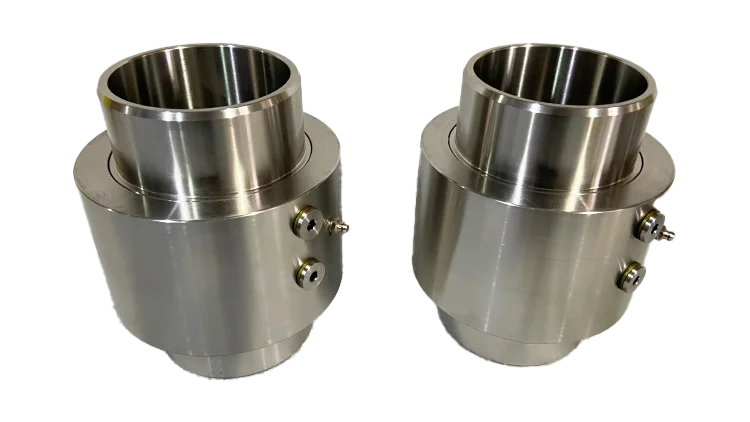
In application scenarios, the leakage rate of some rotary joints can even reach below 10 ⁻⁹ m ³/s, which provides a solid guarantee for the stable operation of photovoltaic tracking systems with almost zero leakage performance.
Conductivity and thermal conductivity efficiency: In addition to sealing performance, conductivity and thermal conductivity efficiency are also important technical indicators of rotary joints. In the photovoltaic tracking system, the rotating joint needs to stably transmit electrical energy to ensure that the solar panel can work properly. To achieve this goal, the rotary joint adopts a combination of copper alloy conductive rings and graphite brushes. Copper alloy has good conductivity, which can effectively reduce resistance and minimize losses during the transmission of electrical energy; Graphite brushes, on the other hand, have low impedance and good wear resistance, and can maintain close contact with conductive rings, ensuring stable transmission of currents ranging from 10A to 200A. The control of temperature rise is crucial in this process. By optimizing design and heat dissipation measures, the rotary joint can control the temperature rise within 30K, which means that during long-term operation, the rotary joint will not be affected in terms of performance and lifespan due to excessive temperature. For some special scenarios that require heat dissipation, such as photovoltaic tracking systems working in high-temperature environments, liquid cooled rotary joints play an important role. This rotary joint adopts a spiral flow channel design, greatly increasing the contact area between the fluid and the inner wall of the joint, allowing heat to be transferred more quickly. Compared with traditional designs, this spiral channel design can increase the thermal conductivity by 25%, effectively reducing the operating temperature of the rotary joint and improving its reliability and stability.
Mechanical lifespan: Photovoltaic tracking systems typically require long-term operation in outdoor environments, which places high demands on the mechanical lifespan of rotary joints. In order to improve the mechanical life, engineers optimized the bearing support structure based on ANSYS simulation technology. Through simulation analysis, it is possible to accurately understand the stress situation of bearings under different working conditions, so as to improve the structure in a targeted manner, enhance the bearing capacity and stability. Meanwhile, the application of silicon nitride ceramic bearings also provides strong support for the long-life operation of rotary joints. Silicon nitride ceramics have the advantages of low density, high strength, high hardness, and good wear resistance, and can maintain good performance under high-speed rotation and high load conditions. Under no-load conditions, the lifespan of rotary joints using silicon nitride ceramic bearings can exceed 5000 hours. Under load conditions, the rotational torque fluctuation of the rotary joint is less than 5%, which means that even under complex working conditions, the rotary joint can maintain stable operation, reduce wear and failure caused by torque fluctuations, and further extend its service life.
022587
(2) The “golden partner” combination scheme with metal hoses
In some complex application scenarios, such as trough solar thermal power stations, the rotary joint needs to work in conjunction with the metal hose to achieve the best dynamic connection effect. The collector of a trough type solar thermal power station not only needs to track the position of the sun to rotate during operation, but also is affected by factors such as thermal expansion and contraction. In this case, the rotary joint and the metal hose each play their respective advantages, forming a perfect combination. The rotary joint is mainly responsible for absorbing angular displacement, and it can easily cope with the rotational offset generated during the tracking of the collector, with a maximum absorption of ± 45 ° angular displacement. Just as the connecting components between the door handle and the door shaft need to be able to rotate flexibly when we turn the door handle, the rotary joint plays a similar role here, ensuring that the connecting pipes of the collector are not damaged due to changes in angle during the rotation process. And metal hoses are mainly used to compensate for axial tension. When the collector operates in different temperature environments, the pipeline will undergo axial expansion and contraction changes due to thermal expansion and contraction. Metal hoses have good flexibility and stretchability, and can effectively compensate for such changes within an axial tension range of ± 50mm, ensuring the normal operation of the pipeline system.
This combination of “rotary joint metal hose” greatly improves the reliability and lifespan of the system. In practical applications, the lifespan of a single component is often only about 3 years, but with this combination scheme, the overall lifespan of the system can be increased to over 15 years. This not only reduces the maintenance cost and replacement frequency of the equipment, but also improves the power generation efficiency and stability of the photovoltaic power station, thus becoming a widely adopted mainstream solution in the industry.
试一试:
AI大模型翻译
Textile Machinery Rotary Joint: A 'Dynamic Bridge' for Steam and Hot Water Transmission
View details
n the vast system of modern industry, heavy equipment is the main force of production, and its efficient and stable...
View details
Rotary joints play a crucial role in the efficient operation of printing and injection molding machines. A high-quality specialized rotary...
View details
n industries such as petrochemicals, metallurgy, and power, rotary joints are key equipment for achieving medium transmission between rotating components...
View details