What is a rotary joints and what is its function
60What is a rotary joint and what is its function, What is a rotary joint, what is rotary joint function
View details rotary joints
Search the whole station
Initially, the application scope of rotary joints was relatively narrow, and some people believed that they were not much different from ordinary faucets. However, with the passage of time, their application has expanded to over thirty major industries. Overall, regardless of the number of industries they are used in, the essence of the joint has not changed. As long as we grasp a few important parameters, we are basically fine. As long as we understand its usage parameters and requirements for the medium, we can correctly choose the rotary joint model suitable for our own application or recommend the correct model to our customers.
When selecting a rotary joint, our first question is usually about the operating temperature. Currently, the heat-conducting oil rotary joints suitable for the market are generally used in equipment with mixed oil, and they even need to withstand high temperatures of around 400℃. Therefore, when selecting a model, we must first clarify the actual operating temperature, and then find a product model that can meet or even exceed the operating temperature. This way, we don’t have to worry about leakage due to temperature issues. Different temperatures require different sealing components. A high-temperature joint can handle low temperatures without any problem, but using a low-temperature joint for high-temperature applications can easily damage the sealing components.
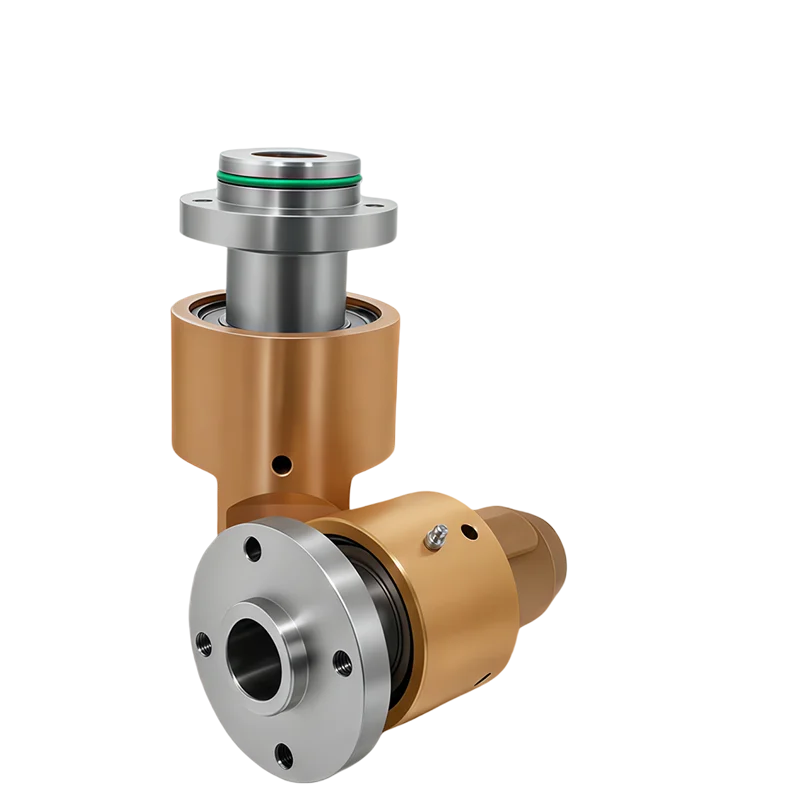
Another parameter is pressure. Currently, the highest pressure in market applications is found in cutting machines used by steel mills and hydraulic presses used by ships, with pressures reaching up to 60-100 MPA. Ordinary rotary joints are unable to withstand such pressure. If an ordinary model is used in high pressure applications, it will inevitably result in seal rupture and air leakage due to high pressure. Therefore, we must be clear about the starting pressure and normal pressure of our equipment, so that we can recommend or choose the correct product.
The last point is about rotational speed. Actually, most rotary joints use bearings to rotate. Generally, speeds of 100-200 revolutions per minute (rpm) are achievable. We usually need to consider high-speed conditions only after ensuring that temperature and pressure requirements are met. Currently, we control high speeds by using high-quality bearings. Seals and high-temperature components are mostly interchangeable, but bearings have some unique characteristics. Generally, high-speed rotary joints are used to pass water medium with a small amount of gas. Since water has a cooling effect, we usually choose imported NSK bearings or domestic RB bearings, which can meet high-speed rotation requirements while preventing rusting of the bearing steel due to water erosion.
What is a rotary joint and what is its function, What is a rotary joint, what is rotary joint function
View details
What is a rotary joint and its working principle, what is a rotary joint, what is a swivel unions, what...
View details
How to maintain a rotary joint, How to maintain a rotary unions, How to maintain a swivel unions
View detailsWhat should be paid attention to when installing a rotary joint, What should be paid attention to when installing a...
View details