How to correctly install and maintain a rotary joints
40how to install and maintain rotary joint, How to correctly install and maintain a rotary joint, right to install rotary...
View details rotary joints
Search the whole station
A high-speed rotary joint is a precision mechanical device used for transmitting fluid media (such as liquids, gases, etc.) under high-speed rotation conditions. It is widely applied in fields such as machine tools, hydraulic systems, and automation equipment. Depending on different application scenarios and technical requirements, high-speed rotary joints are classified into various models. The following are common classification methods and specific models:
1. Classification by technical parameters
1. Classification by rotational speed
Low-speed rotary joint: The rotational speed is generally between 0-100 RPM, suitable for equipment that does not require high rotational speed.
Medium-speed rotary joint: With a rotational speed ranging from 100 to 280 RPM, it is suitable for general industrial equipment.
High-speed rotary joint: With speeds ranging from 280-3000 RPM or even higher, such as the MG012 series which can reach up to 20000 RPM, it is suitable for high-speed rotating equipment.
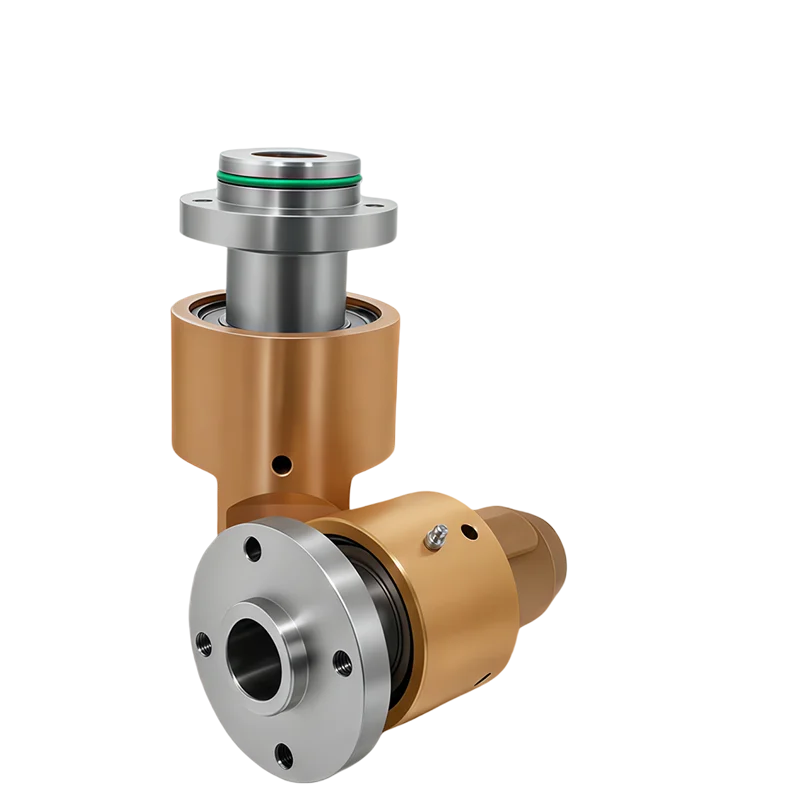
2. Classification by pressure
Low-pressure rotary joint: working pressure is between 0-1.0 MPa.
Medium-pressure rotary joint: Operating pressure ranges from 1.0 to 3.0 MPa.
High-pressure rotary joint: Operating pressure ranges from 3.0 to 21 MPa, or even higher.
3. Classification by temperature
Low-temperature rotary joint: Operating temperature range -80℃~0℃.
Normal temperature rotary joint: Operating temperature range 0℃~80℃.
High-temperature rotary joint: Operating temperature range: 80℃~200℃.
Ultra-high temperature rotary joint: Operating temperature range: 200℃~400℃.
4. Classification by medium
Water rotary joint: suitable for transmitting water, cooling fluid, etc.
Air rotary joint: suitable for transmitting compressed air, vacuum, etc.
Oil rotary joint: suitable for transmitting hydraulic oil, lubricating oil, etc.
Rotary joint for steam: suitable for transmitting saturated steam and superheated steam.
II. Classification by structure and function
1. Single-channel rotary joint
MG035: 1-channel, maximum speed of 1500 RPM, suitable for gases, vacuum, water, oil, and other media.
MG012000: 1-channel, maximum speed of 12000 RPM, suitable for gases, vacuum, water, oil, and other media.
2. Multi-channel rotary joint
MG02250: 2-channel, maximum speed of 150 RPM, suitable for gases, vacuum, water, oil, and other media.
MEH2: 2-channel, maximum speed 4000 RPM.
MEH4: 4-channel, maximum speed 4000 RPM.
MEH6: 6-channel, maximum speed 2000 RPM.
MEH8: 8-channel, maximum speed of 1000 RPM.
3. Special function rotary joint
G-type high-speed rotary joint: It adopts a balanced sealing design, ensuring uniform pressure on the sealing ring and reducing friction, making it suitable for high-speed rotation.
RMH series high-pressure high-speed rotary joint: 2-4 independent channels, with a static pressure independent bearing design, suitable for high-pressure and high-speed working conditions.
III. Classification by sealing form
1. Mechanical seal rotary joint
Adopting a mechanical seal structure, it boasts excellent sealing performance and is suitable for high-pressure and high-speed operating conditions.
MG012 series: Utilizing a flat mechanical seal and ultra-wear-resistant rings, it boasts a maximum rotational speed of up to 20,000 RPM.
2. Hydraulic sealed rotary joint
Adopting a hydraulic sealing structure, it is suitable for hydraulic systems.
IV. Classification by application scenarios
1. Special rotary joint for machine tools
MG012 series: suitable for the transmission of machine tool coolant and hydraulic oil, with a maximum speed of up to 20,000 RPM.
HS-G type: High-speed rotary joint, featuring a balanced sealing structure, suitable for high-speed equipment such as machine tools.
2. Universal industrial rotary joint
Type Q rotary joint: suitable for media such as saturated steam and superheated steam, with a rotational speed of ≤100 RPM.
H-type rotary joint: suitable for high-pressure and high-speed conditions, with a rotational speed of ≤3000 RPM.
V. Classification by model naming conventions
The model number of a high-speed rotary joint typically includes the following information:
– Company name: such as MG, XTGS, etc., indicating the manufacturer.
– Function code: For example, “GS” indicates high speed, and “H” indicates end face seal.
– Structure code: For example, “S” indicates bidirectional flow.
– Internal model code: For example, “Y” represents the internal model of the enterprise.
how to install and maintain rotary joint, How to correctly install and maintain a rotary joint, right to install rotary...
View details
What should be considered when selecting a rotary joint, how to select a rotary joint, rotary joint
View detailsWhat is a rotary joint and what is its function, What is a rotary joint, what is rotary joint function
View details
What is a rotary joint and its working principle, what is a rotary joint, what is a swivel unions, what...
View details