
Dismantling and maintenance methods for rotary joint
Dismantling and maintenance methods for rotary joints, Dismantling and maintenance methods for rotary joint, Dismantling and maintenance methods for rotary unions, Dismantling and maintenance methods for rotary union, Dismantling and maintenance methods for swivel joints, Dismantling and maintenance methods for swivel joint, Dismantling and maintenance methods for swivel unions, Dismantling and maintenance methods for swivel union
A rotary joint is a connecting sealing device that inputs fluid medium from a stationary pipeline into rotating or reciprocating equipment, and then discharges it from the rotary joint. When installing a rotary joint, attention should be paid to:
1. During the handling and storage of rotary joints, collisions and drops should be avoided to prevent damage to the interface and internal components.
2. Install the rotary joint as concentric as possible to ensure good operation of the rotary joint.
3. When installing the rotary joint with threaded connection, attention should be paid to whether the thread direction of the inner and outer pipes corresponds to the rotation direction of the drum, and the thread direction of the inner and outer pipes should also be consistent.
4. The connection between the rotary joint and the pipeline must be made using flexible hoses (our company recommends using metal hoses with good flexibility), and rigid connections are absolutely prohibited.
5. The inlet and outlet of the rotary joint should be directly connected to the hose as much as possible. To reduce the auxiliary weight of the joint and extend its service life.
6. The assembly of the inner tube should pay attention to the matching of dimensions and the auxiliary support of weight. It is recommended to use tolerance fit H8/e7 for the fit between the inner tube and the joint of the internal rotary joint.
7. The support and anti rotation of the rotary joint should be appropriate. Generally, the diameter of the rod should be 2mm smaller than the anti rotation hole to avoid affecting the free adjustment and compensation of the rotary joint.
Due to the unique usage environment, rotary joints are often subjected to high temperature, high pressure, and high speed production environments. Regular testing and maintenance are required for long-term use. What are the common maintenance knowledge for rotary joints?
1. The rotating joint drum and the interior of the pipeline should be kept clean. Special attention should be paid to new equipment, and filters should be added if necessary to avoid abnormal wear of rotating joints caused by foreign objects.
2. Long term disuse of the machine can cause scaling and rusting inside the rotary joint. Please be aware that there may be jamming or dripping when reusing.
3. If equipped with an oil injection device, please inject oil regularly to ensure the reliability of the rotating joint bearing operation.
4. The rotating joint of the circulating heat medium should gradually warm up to avoid sudden temperature changes.
5. Check the wear condition and thickness change of the sealing surface (usually normal wear is 5-10mm); Observe the friction trajectory of the sealing surface to see if there are any issues such as three-point interruptions or scratches. If there are any such problems, they should be updated immediately.
Rotary joints are a unique and specialized product because they can withstand very high pressure while rotating at very high speeds. To achieve this, it is necessary to make the sealing surface achieve a nearly perfect fit, that is, the seal must be slightly overlapped, without considering the pressure factor of the medium, and the load or pressure loaded on the sealing surface must be kept to a minimum, and it can rotate smoothly and stably to reduce friction to the lowest limit, in order to extend the service life and ensure no leakage.
When using a rotary joint, it is necessary to install, disassemble, and maintain it according to the correct method to ensure that the joint can operate normally and extend its service life. The scope of application of rotary joints varies and should be selected according to actual needs.
Before disassembling the rotary joint, cut off the power supply of the equipment to stop it from running. Remove the rotary joint from the equipment and place it on the workbench;
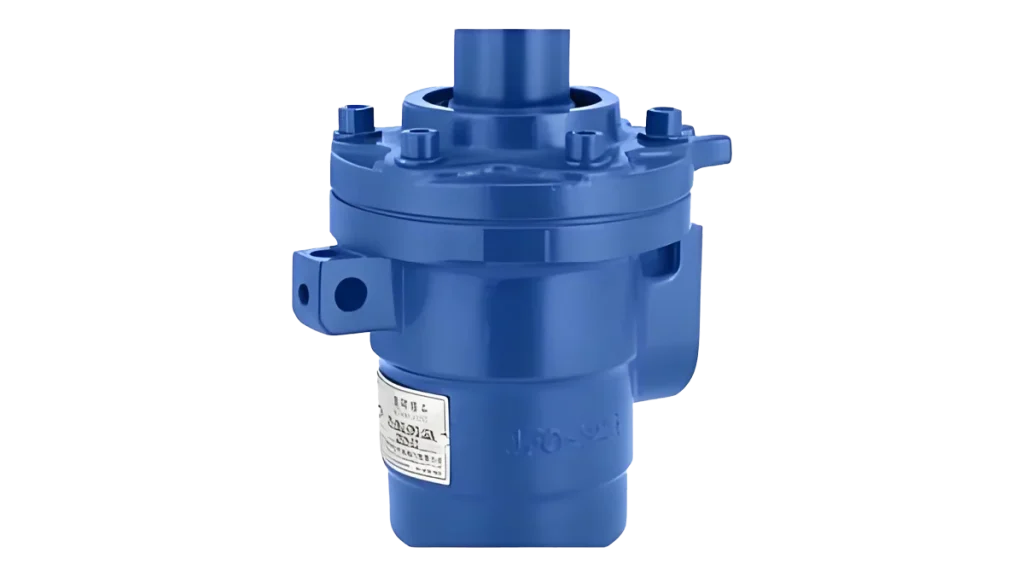
Remove the metal hose, transition joint, and transition flange connected to the rotary joint;
On the workbench, disassemble the rotary joint, remove the internal parts, and then perform maintenance.
When repairing the rotary joint, the graphite sealing ring is the most important sealing element inside the rotary joint. The convex spherical surface of the outer tube in contact with the graphite sealing ring forms a sealing surface, and the flat surface of the bottom cover in contact with the graphite sealing ring forms a sealing surface;
Check the sealing surfaces of the convex spherical surface of the outer tube seal and the bottom plane of the bottom cover of the rotary joint for defects such as grooves, rust, cracks, ruptures, and uneven wear. For surface scratches on the sealing surface, they can be ground with sandpaper (oil sand) or sandpaper. For irreparable defects, replacement repair should be carried out.
Observe the friction surface of the graphite sealing ring sealing surface of the rotary joint, check for defects such as eccentric wear, three-point contact, or discontinuous sealing surface disconnection. If the sealing ring is worn or has cracks, ruptures, or damages, it should be replaced in a timely manner;
If there are impurities in the circulating liquid medium, they should be cleaned up in a timely manner, and a filter screen should be added to the pipeline. The recommended filtration accuracy is not less than 50 microns.