
What are the commonly used classifications of rotary joint
based on the pathway of the rotary joint, there are single pathway rotary joints, double pathway rotary joints, and multi pathway rotary joints
Rotary joints are sealed transmission devices, and different sealing rings are selected according to the requirements of the usage environment and transmission medium.
1. According to the medium of use, it can be divided into thermal oil rotary joints, steam rotary joints, water rotary joints, compressed air rotary joints, etc. 2. According to the number of pathways, it can be divided into single pass rotary joints, double pass rotary joints, and multi pass rotary joints. 3. According to the sealing form, it can be divided into mechanical seal rotary joints and hydraulic seal rotary joints. 4. According to pressure, it can be divided into low-pressure rotary joints, medium pressure rotary joints, and high-pressure rotary joints. 5. According to temperature, it can be divided into normal temperature rotary joints and high temperature rotary joints.
Rotary connector classification: Rotary joints and slip rings: Rotary joint classification: Pneumatic rotary joint, Hydraulic rotary joint, High speed rotary joint, High pressure rotary joint, High temperature rotary joint Slip ring classification: signal slip ring, power slip ring, Ethernet slip ring, USB slip ring, CAN bus slip ring, wind power slip ring, servo motor slip ring, etc The above is a rough classification of rotary connectors
Today we will mainly talk about how to choose the types of rotary joints mentioned above. Pneumatic rotary joints are mainly used for conveying gas media such as air and vacuum. The maximum pressure resistance of conventional products is 10 Bar (standard industrial pressure is 5-8 Bar), and the standard product speed is within 600 RPM. If our medium is air or vacuum, then we choose the type of pneumatic rotary joint, which is widely used in automation equipment
Hydraulic rotary joints are mainly used for conveying fluid media such as water cutting fluid, hydraulic oil, paint, etc. The basic pressure resistance of conventional products is 350 Bar (the maximum pressure of conventional hydraulic is 250 Bar), and the maximum speed of standard products is 200 RPM. If we need to simultaneously pass gas, water, oil and other media, then we can choose hydraulic rotary joints. Their products are mainly used in high-pressure environments and have good sealing performance. They are widely used in construction machinery, such as excavators, fire trucks, drilling rigs, tree movers, etc
High speed rotary joints are mainly used for conveying cutting fluid and hydraulic oil. The standard product has a pressure resistance of 250 Bar and a standard speed of 3000 RPM or less. High speed rotary joints have relatively high requirements for the medium, and the medium must not contain particle impurities, otherwise it will directly cause the high-speed rotary joint to get stuck or damaged. High precision suspension bearings are used internally to support the non-destructive rotation of the entire rotor, with a long service life. It is widely used in the transformation of CNC machine tools
High pressure rotary joints are mainly used for conveying hydraulic oil. The standard product has a maximum pressure of 1000Bar and a maximum speed of 50RPM. It is mainly designed for maritime and petroleum exploration. The internal structure adopts a bearingless structure, effectively improving the service life of the product. The groove structure design is adopted to effectively reduce the damage caused by pressure to the product. If our medium pressure is relatively high, then we should choose high-pressure rotary joints instead of ordinary ones to avoid safety accidents caused by high pressure. The overall design adopts steel structure, which effectively resists pressure,
High temperature rotary joints are mainly used for transmitting steam and some rare high-temperature gases. The temperature resistance of general high-temperature products is 380 ° C, and the temperature resistance requirement with special requirements is 700 ° C. The sealing of high-temperature rotary joint products comes entirely from abroad, and domestic sealing cannot meet their product requirements. At the same time, the demand for high-temperature rotary joint products is small, the production process is complex, and the product unit price is high
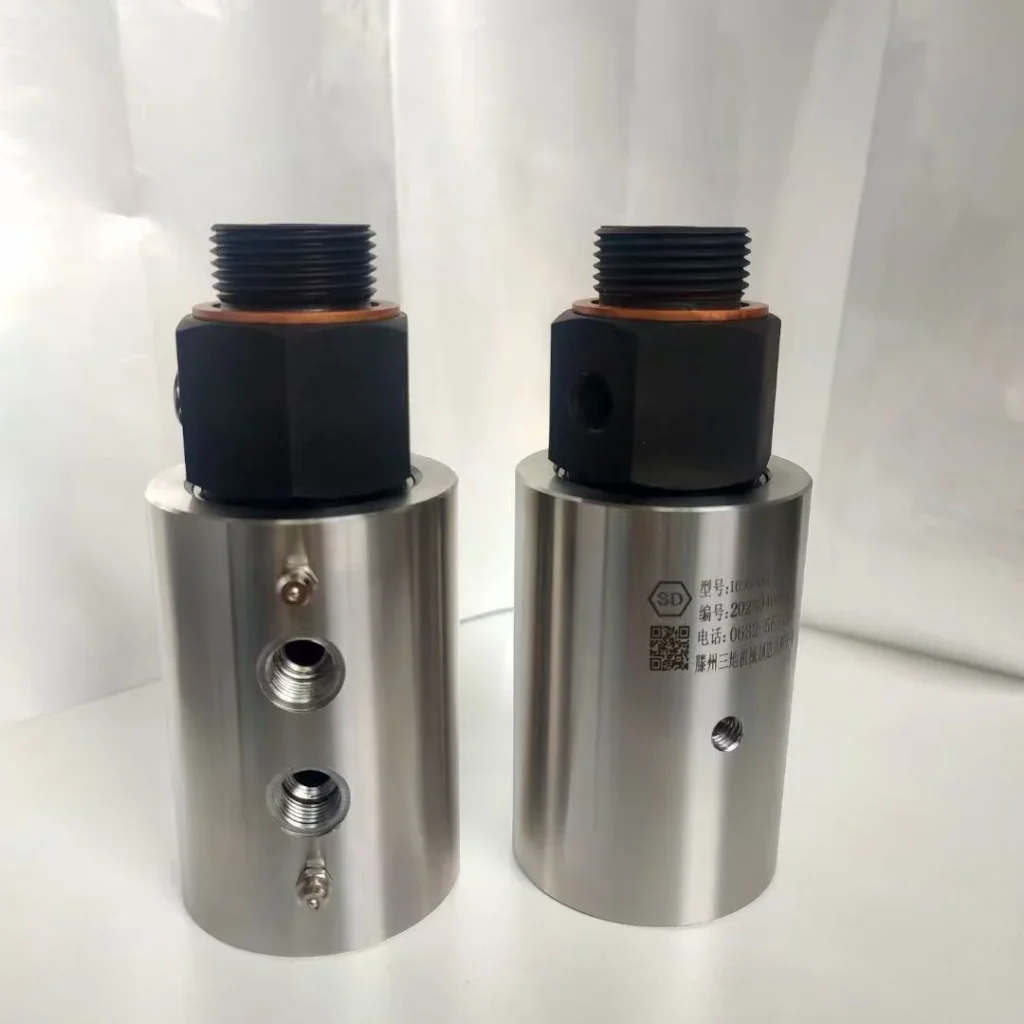
Selection guide:
1. Unidirectional flow type: Install rotary joints at both ends of the drum, allowing fluid to enter from one end and exit from the other end without using an inner pipe.
2. Unidirectional flow type: A rotary joint is installed at one end of the drum, and fluid is introduced and discharged at this end. The rotation of the inner pipe relative to the drum is stationary.
3. Bidirectional flow type (fixed inner tube): The difference from the previous type is that the drum is equipped with different types of siphon tubes to discharge the condensate. This type is mostly used for steam type.
4. Bi directional flow type (inner tube rotation): This type is used for structures where the inner tube is relatively fixed to the drum and rotates synchronously with the drum. At this time, fluid is introduced through the inner tube and discharged through the outer tube.
5. Bidirectional flow type (inner tube rotation): A siphon is installed inside the drum to synchronize with the drum and discharge the condensate. This type is mostly used for steam type.