
Introduction to slip rings stability
Introduction to slip ring stability
The main technical indicators of slip rings include insulation performance, anti-interference performance, contact resistance, etc. This article analyzes the precision conductive slip rings widely used in astronomical navigation, optoelectronic tracking, optoelectronic measurement, and optoelectronic search equipment, one by one, based on the above three issues. As a key component of automation equipment, the stability and reliability of slip rings are closely related to the stability and reliability of the entire equipment. It can be said that the former determines the latter. Therefore, high-quality slip rings are extremely critical for high-precision instruments and equipment.
For slip rings, the greater the dielectric strength, the better. The indirect resistance of the slip ring should at least exceed the compression resistance without being penetrated. Otherwise, the reliability of the slip ring will be very difficult to achieve. An electric slip ring consists of many rings. The smaller the distance between the rings, the better. However, in reality, this depends on whether grooves can be produced. The key is to ensure the compressive strength of the insulating layer between the rings after gluing. The axial size of conductive slip rings is large, making them easy to bond, while small sizes are difficult to bond. The key to the compressive strength of the insulation layer lies in the secret formula of the insulation layer chemicals and the entire process of glue processing. As conductive slip rings that transmit electronic signals and microwave heating data signals, the higher the anti-interference performance, the more reliable the data transmission. In fact, the slip ring transmits dozens of different electronic signals, including high-voltage alternating current, power frequency alternating current, weak alternating current, small data volume, and high-flow alternating current. Due to the close proximity of conductive slip rings, various data signals interact with each other during the entire transmission process. There are also discharge disasters, electromagnetic field magnetic induction coupling, and magnetic field magnetic induction coupling. The discharge coupling effect is discussed.
Insulation performance
As a conductive slip ring for transmitting electrical and microwave signals, the better the anti-interference performance, the more reliable the data transmission. In reality, slip rings transmit dozens of different electrical signals, including high-voltage AC, high-frequency AC, weak DC small signals, and high current AC. Due to the close distance between conductive slip ring rings, various signals interfere with each other during transmission, as well as electrostatic induction coupling, magnetic field induction coupling, and electromagnetic field induction coupling. The interference caused by electrostatic induction coupling and other factors seriously affect the accuracy of information transmission. Therefore, to improve the anti-interference performance of slip rings, we need to start from the above main factors
For slip rings, the higher the insulation performance, the better. At the very least, the insulation resistance between rings should be greater than the withstand voltage without being broken down, otherwise the reliability of the slip ring is prone to problems. An electric slip ring is composed of many rings, and the smaller the distance between the rings, the better. In reality, it depends on whether the groove can be processed, and more importantly, the insulation strength between the rings can be ensured after gluing. The radial size of the conductive slip ring is large, making it easy to apply glue, while the size is small, making it difficult to apply glue. Its insulation strength also depends mainly on the formula of the insulation material and the glue application process..
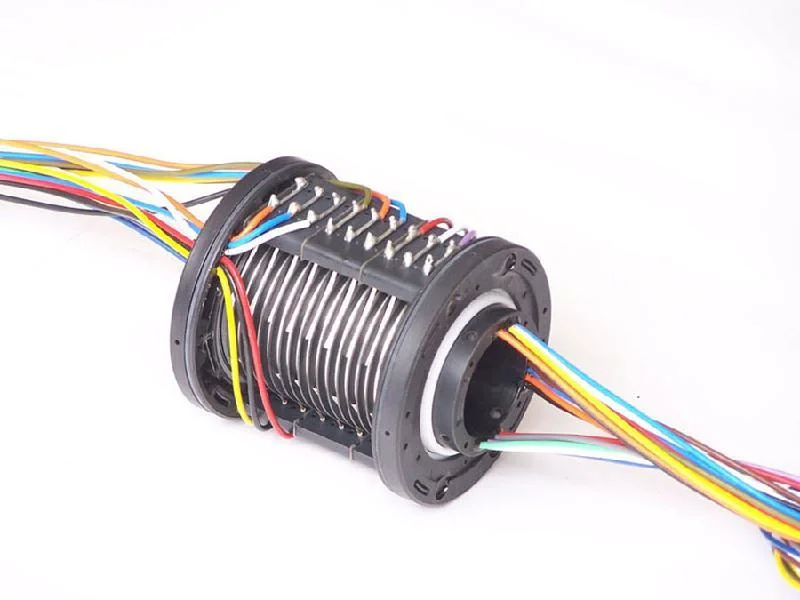
The main components of the slip ring are the conductive ring and the brush. They maintain contact between the media inside the slip ring. They can rotate to transmit signals. When the intelligent robot is in an active state, it relies on the conductive ring and brush inside the conductive slip ring to rotate, enabling the intelligent robot to fully receive instructions from the core host while rotating and avoiding interference. The damage caused by the twisting of wires during interaction is analyzed.
The micro conductive slip ring can transmit both small and large currents, ranging from tens of milliamps to hundreds of amps. Besides current, it can also handle various signals such as fiber optic signals, servo motor signals, high-frequency signals, USB signals, industrial Ethernet signals, and common switch signals. Despite the limited installation space, the signal transmission is stable, with no distortion, packet loss, or code interference occurring.