
High end rotary joint design
High end rotary joints design
The part that can rotate 360 ° in daily life is called a rotary joint, which is characterized by the ability to input fluid and gas mechanisms from a stationary pipeline into rotating or reciprocating equipment, and then discharge them from the sealing device of the rotary joint. The circuit rotary joint can choose the connection form according to the working situation, and the direction of medium entry depends on the specific working environment. There are multiple different connection methods and medium entry choices. The sealing surface is made of special wear-resistant materials, which are wear-resistant, corrosion-resistant, have good sealing performance, and long service life. There are two high-precision bearings inside to support the balanced and stable rotation of the entire rotary joint. Observation holes are set outside the single circuit rotary joint and double rotary joint to observe the wear of the internal seals at any time. If… Serious wear and tear was found, New sealing components can be replaced without the need to purchase new ones, saving costs. Various media such as fluid media, water, steam, oil, cutting fluid, air, vacuum, chemical agents, etc. can be introduced. Multi path rotary joints are mainly composed of multiple pipe diameters. For joints with 2 or more passages, we usually refer to them as multi path rotary joints. There are multiple inlet and outlet holes for the medium, and the inner pipes are independent of each other without affecting their work. There are imported high wear resistant seals inside, which have good wear resistance, high temperature resistance, corrosion resistance, and long service life. Each ring is sealed by two different forms of seals, and there are two precision bearing devices inside. On a rigid shaft, there is no vibration during long-term operation, and the shaft needs to undergo special heat treatment to increase its rigidity, The fixed ring closure is made of special materials with corrosion resistance and wear resistance. In general, due to the large number of channels and joint sizes in the multi-path rotary joint, in order to reduce the weight of the joint, the outer shell is usually made of aluminum alloy and the rotor is made of stainless steel. The biggest feature of its sealing element is the labyrinth component seal, which ensures good sealing performance
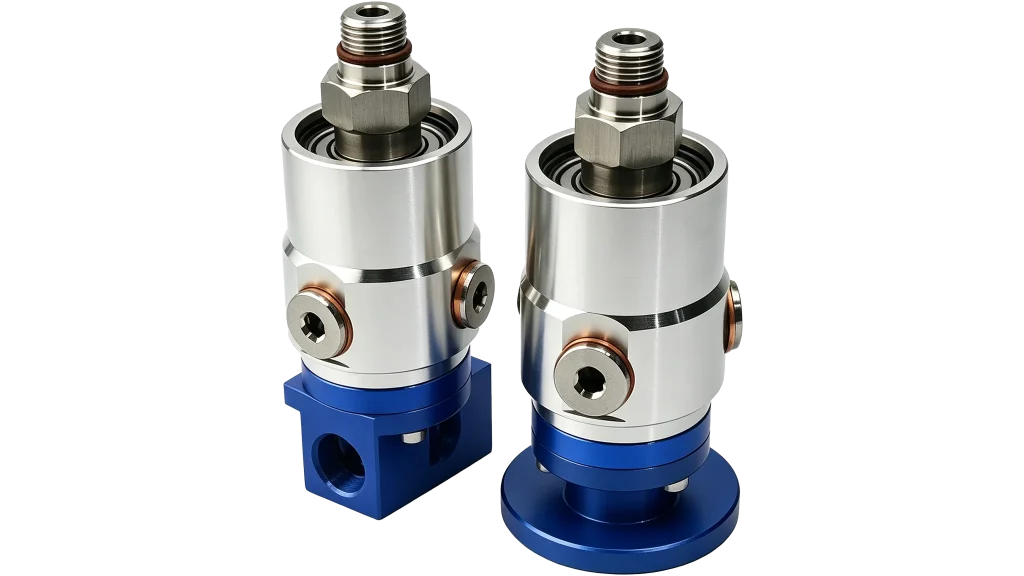
Innovative Approaches to Rotary Joint Design
Rotary joints make it possible to transfer signals, power, fluids, or optical data between stationary and rotating parts without interrupting motion. A thoughtful rotary joint design does more than “make a connection”; it protects signal integrity, manages mechanical stress, supports long service life, and helps the wider system perform reliably. As applications become more compact, data-rich, and demanding, engineers are rethinking how waveguide, coaxial, fibre optic rotary joints are specified and integrated.
What makes rotary joint design challenging?
Rotary joint design is challenging because it sits at the intersection of motion, transmission performance, environment, and manufacturability. A design that works mechanically may still introduce signal loss, leakage, impedance mismatch, optical attenuation, or wear if the transfer path is not managed carefully. The best outcomes usually come from treating the rotary joint as a system component rather than a standalone hardware item.
In practical terms, every design decision has a trade-off. Higher rotational speed may call for tighter balance and bearing control. Higher frequency operation may reduce tolerance for discontinuities in the signal path. A compact envelope may limit routing options, thermal dissipation, or sealing choices. When these factors are considered early, the joint can support the equipment instead of becoming a late-stage constraint.
The role of the application in shaping the design
A rotary joint used in a radar platform, an antenna pedestal, a medical scanner, an industrial robot, or a rotating sensor assembly will not face the same priorities. Some systems care most about insertion loss and phase stability. Others prioritize rugged sealing, long maintenance intervals, or mixed-media transfer through a single rotating interface.
A practical starting point is to define what must pass through the joint and what conditions it must survive. This includes signal type, bandwidth, rotational speed, duty cycle, torque limits, temperature range, vibration, space constraints, and maintenance expectations. Without that operating picture, even a technically impressive design may be poorly matched to the job.
Useful specification questions include:
- What is being transmitted: RF, microwave, optical data, power, fluid, gas, or a combination?
- Is continuous rotation required, or is the motion limited to a defined angle?
- What level of signal loss, reflection, attenuation, or phase variation can the system tolerate?
- Will the joint operate indoors, outdoors, in a marine environment, or under high vibration?
- How much space is available for bearings, seals, channels, connectors, and strain relief?
- What maintenance access will be available after installation?
These questions keep the design grounded in real operating needs, not just component preferences.