
fiber optic rotary joint
fiber optic rotary joint, fiber optic rotary joints, fiber optic rotary union, fiber optic rotary unions, fiber optic swivel union, fiber optic swivel unions, fiber optic swivel joint, fiber optic swivel joints
Fiber optic rotary joints (fiber optic slip rings) are similar to conductive slip rings, but use light as the transmission medium. Fiber optic rotary joints (FORJs) come in two forms: single channel and multi-channel. They break through the existing transmission distance and are devices that allow light or optical signals to be transmitted between fixed structures and continuously rotating components. Fiber optic rotary joints, sometimes also known as fiber optic slip rings, inherit the advantages of long service life, fast transmission speed, fast operation speed, safety and reliability of optical communication equipment.
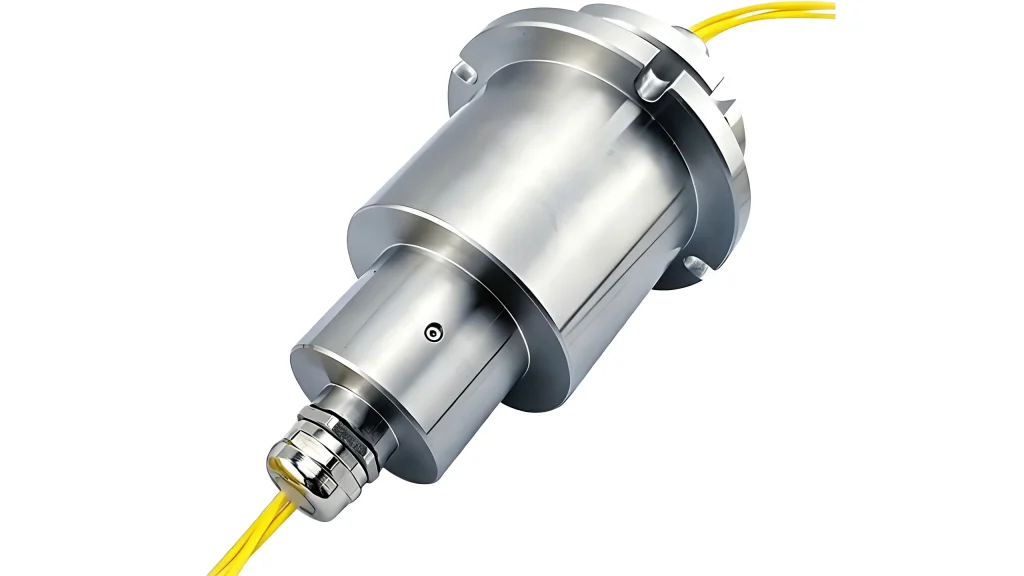
At present, there are more than 50 types of SD, which can be divided into coaxial rotation and non coaxial rotation; There are intermediate optical components and no intermediate optical components; Single channel and multi-channel; Multimode and single-mode, etc. Multi mode SD completes the rotational coupling of multi-mode optical fibers. The core diameter of multimode fiber is relatively thick, about 50.0-62.5 μ m, making beam coupling easy, device manufacturing difficult, and cost-effective. However, multimode fiber optic transmission has high loss and small bandwidth, and is generally used in short distance and low-speed applications. Single mode SD achieves coupling between single-mode fibers, with low transmission loss and large bandwidth. When combined with wavelength division multiplexer, it has a wider bandwidth and can be used for long-distance, high-capacity signal transmission. However, the core diameter of single-mode fiber is relatively thin, less than 10 μ m, making beam coupling difficult, device manufacturing challenging, and costly.
At present, there are mainly two types of SD structures: a. docking type, which is a rotary connection that directly uses fiber optic end faces for docking, without optical components in the middle of the device; b. Beam expansion type, which is a beam expansion rotating connection with an optical lens added between two optical fibers. The multi-mode fiber optic rotation connection of these two structures is relatively mature. The mode field diameter of single-mode fiber is very small, only a few micrometers, and the numerical aperture is also small. Therefore, in the implementation of rotational connection of single-mode fiber, the coupling difficulty of docking type is quite high.
The rotation connection principle of docking type SD is very similar to current active fiber optic connectors, but the end faces of the two fibers must maintain an appropriate gap of about a few micrometers to ensure that the rotation loss of the two fibers is small and that there is no friction between the fiber end faces. In this structure, the main factors affecting the optical coupling efficiency are the end face gap, lateral misalignment, and angular deviation between the optical fibers. The gap between fiber end faces and lateral misalignment have a significant impact on coupling efficiency, while the influence of angle deviation is relatively small. The main advantage of this method is its simple structure, but the insertion loss is relatively high.
The expansion type SD adds a lens between the two fiber end faces, making the structure more complex. Generally, a λ/4 fiber self focusing lens is used, and the size and wavelength of the lens must match the fiber. The main reasons affecting the optical coupling efficiency are still the axial gap, lateral misalignment, and angular deviation between the two lenses. After adopting beam expansion, the transmission beam between lenses changes from the original conical beam to a parallel beam. Therefore, the axial gap has little effect on the coupling efficiency, and the lateral misalignment has a reduced impact on the coupling efficiency compared to butt type connections. However, the impact of angular deviation becomes very significant. Changing the conical beam connection between two fiber end faces to a parallel beam connection between two lenses can create a certain distance between the fibers, and the coupling loss is almost unaffected by temperature changes. In addition, after the lens expands the beam, the requirement for rotational eccentricity is reduced. Therefore, the insertion loss and its variation of this structure are relatively small.
Single channel SD arranges two optical fibers in a straight line (aligned), with one fiber fixed and the other fiber rotating along the axis. The mechanical structure is simple, easy to process, the device is compact, the cost is low, the insertion loss is small, and it is easy to achieve high-speed rotation. Due to having only one fiber channel, the types and rates of transmitted signals are limited. To improve transmission capacity, it is necessary to use it in conjunction with a wavelength division multiplexer.
The rotational coupling between multi-channel SD optical channels is ensured by the intermediate FORJ, and the key technology is to find the optimal rotational structure to reduce wavelength related losses, polarization related losses, polarization mode dispersion, and crosstalk that exist in multi-channel rotating joints without compromising the general performance of the device. According to the relative positions of the incident and outgoing fiber ports at both ends of FORJ and the rotation axis, FORJ can be divided into two types: off-axis at both ends, off-axis at one end, and coaxial at the other end. The input and output fiber ports of each channel of the off-axis multi-channel FORJ are parallel or perpendicular to the rotation axis, and the rotational coupling of optical signals is achieved through optical devices such as Dove prisms, lens groups, and mirror groups. The multi-channel FORJ structure is complex, with high insertion loss and crosstalk between channels. Currently, mature products generally only have 4 channels.
The multi-channel SD with Dawei prism as the core utilizes the image conversion principle of Dawei prism to couple multiple optical signals and achieve channel docking. Fiber 1 and 3 in the rotor and fiber 2 and 4 in the stator are both off-axis and parallel to the axis of rotation. In a parallel beam, when the Dawley prism rotates at half the rotational speed of the rotator, the position imaged by the prism does not change. When the rotor composed of channels (optical fibers) 1 and 3 rotates around the axis of rotation, the parallel light emitted passes through the Dawley prism rotating at half the speed of the rotor, and in the stator, channels 1 and 2 and channels 3 and 4 correspond one-to-one. This FORJ can transmit optical signals bidirectionally, but it requires the prism to rotate at half the speed of the rotator, and there must be precise installation positions between channels. The machining and assembly accuracy of mechanical components and transmission gears are high, and the cost of the device is high. In addition, optical signals of different wavelengths refract in different paths in the Dawei prism, causing the position of the optical signal exiting the prism to change accordingly, scattering occurs, and some light cannot enter the outgoing fiber, resulting in significant insertion loss.
The multi-channel SD with lens group as the core uses two symmetrical optical lenses to transmit signals from the rotor composed of channels (fibers) 3 and 4 to the stator composed of channels 1 and 2. The common optical axis of the lens determines the rotation axis of the rotary connector. Each lens group consists of a large-diameter plano convex lens and a small-diameter plano concave lens. A large lens converges and deflects parallel incident light beams towards the optical axis, while a small lens reduces the angle between the light beam and the optical axis, allowing more light to couple with the optical hole of the self focusing lens on the fiber and output. The distance between two lens groups is determined by the focal length of the plano convex lens, that is, one group of lenses is placed inside the focal point of the other group of plano convex lenses near the focal point. When the rotor rotates around the axis of rotation, the light transmitted from channel 3 always corresponds to channel 2 through the lens group, and channel 1 corresponds to channel 4, ensuring continuous bidirectional transmission of the optical signal. The optical components of this FORJ are simple, consisting of ordinary spherical lenses with low production costs. The disadvantage is that the system requires a precise mechanical structure to ensure the position of the optical fibers and smooth rotation of the optical components, otherwise the insertion loss will be large, and each group of optical channels can only transmit unidirectionally.
A multi-channel SD with a reflector group as the core, where fibers 1 and 2 in the rotor are parallel to the axis of rotation, and fibers 3 and 4 in the stator are perpendicular to the axis of rotation. The optical signal in coaxial fiber 1 is reflected by a mirror 1 at a 45 ° angle to the rotation axis and directed onto the side fixed fiber 3; The optical signal in off-axis fiber 2 is coupled to another bent fiber 5 that rotates synchronously with the off-axis fiber. The other end of the bent fiber 5 is located on the axis of rotation, becoming a coaxial fiber. Its output optical signal is reflected by the mirror 2 and directed to the fixed fiber 4 on the other side. After multiple couplings of bent fibers, mirrors, and fixed fibers, the loss of off-axis fibers is relatively high. As the number of optical channels increases, the axial and lateral dimensions of the device will sharply increase.
One end is off-axis and the other end is coaxial. One end of the multi-channel SD has fiber optic ports parallel to the rotation axis, while the other end has ports placed at different positions on the rotation axis. The most representative is the spectral structure with Fresnel lens as the core, and the radial distribution area of the lens has different focal lengths. By utilizing the series of focal points of Fresnel lenses, the multi-channel optical paths of the off-axis and rotating parts on the rotating axis are coupled and converged onto different focal points on the rotating axis, serving as a rotational connection. With the assistance of precision mechanical structures, the optical axis of the lens coincides with the axis of the FORJ. The light rays emitted from off-axis channels 2 and 3 converge to different positions on the optical axis under the convergence effect of the Fresnel lens. The outgoing optical fibers are placed at these positions to receive the transmitted optical signals. When channels 1, 2, and 3 rotate around the optical axis, the outgoing optical fibers on the axis continuously receive the optical signals transmitted from channels 1, 2, and 3, ensuring continuous transmission of the optical signals through the rotating surface. The biggest advantage of this structure is that the axial dimension can be made very short and the structure is compact. The disadvantage is that each channel cannot transmit bidirectionally, that is, light cannot be transmitted from different focal points to the corresponding optical path of the rotating part one by one, and the crosstalk between each channel is large.